
Review-only branding check: The current header image preview remains unpublished and requires remediation before approval because the visible emblem overlay does not match the requested canonical source
https://cdn.marblism.com/XFRXHZttb5a.webpas an untouched static post-process overlay. Any final replacement preview must preserve article-derived quote callouts in white lettering with metallic-blue key words and remove any retired or forbidden terminology.
Collateral value can erode before delinquency appears.
Your loan portfolio may be carefully monitored for payment performance, credit score movement, insurance status, and delinquency trends. But there is another exposure that can remain invisible until recovery time:
The financed vehicle may no longer be worth what your records assume.
A collision can reduce collateral value. An incomplete repair can deepen that reduction. A premature total-loss decision can create a dispute over the asset’s true value. A repaired vehicle can still carry diminished market value after the claim is closed.
None of these events automatically creates a loss for the credit union. But each can create potential portfolio exposure: especially when the outstanding balance is higher than the vehicle’s post-event value.
The gap may reach millions of dollars in a large portfolio. The exact exposure depends on loan volume, claim frequency, balances, repair outcomes, depreciation, insurance coverage, and market conditions.
This is not a guaranteed or universally measured loss.
It is a visibility problem. And visibility is the first line of protection.
The hidden collateral gap
A traditional loan file tells you what was financed, how much is owed, and whether payments are current. It may contain an original valuation, insurance information, and lien documentation.
What it often does not contain is a consistent, time-stamped record of the vehicle’s condition throughout the loan lifecycle.
That creates a dangerous half-equation:
- Payment performance is visible.
- Collateral condition may not be.
A member can remain current on every payment while the asset securing the loan loses value after a collision. If the vehicle is repaired incompletely, repaired with disputed scope, or repaired without clear documentation, the credit union may not learn about the collateral deterioration until the borrower refinances, trades in the vehicle, defaults, or the loan reaches recovery.
By then, the financial wound may already be established.
“A loan file is not a collateral inspection.”
This distinction matters because vehicle value is not static. It changes with mileage, depreciation, market demand, accident history, repair quality, and structural or safety concerns.
One damaged vehicle can change the LTV equation
Consider an illustrative example.
A member owes $31,000 on a vehicle that had an estimated pre-loss market value of $34,000. On paper, the loan appears to have approximately 91% LTV.
Now suppose the vehicle is involved in a collision.
The carrier’s initial estimate does not reflect the complete repair scope. The member receives a payment, but certain repairs remain incomplete. The vehicle is eventually repaired enough to remain operational, but its market value is now estimated at $26,000 because of the accident history and unresolved condition concerns.
The loan balance may still be $31,000.
The collateral gap is now approximately:
$31,000 loan balance – $26,000 estimated vehicle value = $5,000 potential shortfall
That does not mean the credit union has immediately lost $5,000. The borrower may continue paying. The vehicle may sell for more or less than the estimate. Insurance, GAP coverage, repossession costs, market conditions, and other factors may change the outcome.
But the original LTV assumption is no longer reliable.
The asset has changed. The file has not.
The portfolio-level math
Portfolio exposure becomes significant when a small percentage of loans experience a meaningful collateral gap.
Here is a clearly labeled illustrative example:
- 50,000 auto loans
- 2% experiencing a documented collision or severe damage event during a measurement period
- 1,000 affected vehicles
- $4,000 average potential collateral gap per affected vehicle
1,000 vehicles × $4,000 = $4 million in potential exposure
Again, this is not a prediction, industry average, or guaranteed loss estimate. It is a framework for understanding how individual documentation gaps can scale across a portfolio.
A smaller credit union might have a substantially different result:
- 10,000 auto loans
- 1% affected vehicles
- $3,500 average potential gap
100 vehicles × $3,500 = $350,000 in potential exposure
The purpose of this math is not to create alarm without context. It is to give executives a disciplined way to ask better questions:
- How many financed vehicles experience collision damage each year?
- How often does the credit union receive notice?
- How many repairs are documented as complete?
- How often do members report a total-loss dispute?
- How much diminished value may remain after repairs?
- What portion of affected loans carry high LTVs?
If you cannot answer those questions, your portfolio may have a collateral blind spot.
Four documentation checkpoints for the loan lifecycle
Claim Stinger is designed to help organize member-generated documentation at key points in the asset lifecycle. It is not a substitute for underwriting, insurance coverage, legal advice, appraisal expertise, or internal risk controls.
It can, however, give the credit union and its members a more consistent record to review.
1. Vehicle Condition Report: establish the baseline
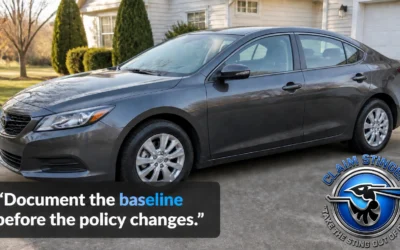
A Vehicle Condition Report creates a time- and date-stamped record of the vehicle’s condition and mileage.
For a credit union, this can help establish a clearer baseline near origination, refinancing, policy changes, or other defined points in the relationship.
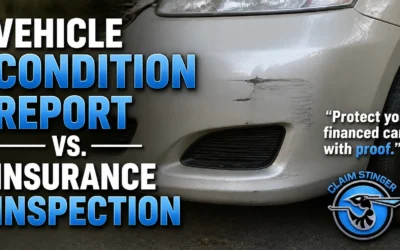
The value is not polished photography. It is the truth as captured at that moment using a consumer-grade device. Images should show the vehicle as-is, including meaningful pre-existing damage.
Apply the Credit Card Rule: damage should generally be treated as reportable when it is larger than a standard credit card: approximately 2.5 by 4 inches. Ordinary wear, small surface marks, and routine use are not automatically reportable damage.
A consistent baseline may help reduce disputes about whether a condition existed before a later event.
2. Initial Damage Estimate Report: identify the scope when available
An Initial Damage Estimate Report is intended to document collision or hail-related damage and organize the information needed for repair-scope review.
This product is coming soon and is listed at $70 when available. It should not be presented as currently available.
When released, its role will be to help members document the visible damage and compare the reported condition against the proposed repair scope. It should not be treated as a guaranteed valuation, coverage determination, or insurer outcome.
For credit unions, the strategic value is early visibility: knowing that a financed vehicle may have experienced a material event before the collateral gap becomes visible during default or disposition.
3. Closed Claim Report: confirm the repair record
A Closed Claim Report functions as a digital completion file for the member’s claim.
It can organize claim information, repair documentation, receipts, and supporting records after work is completed. The current listed price is $19.
A closed claim file does not guarantee that every repair was performed correctly or that an insurer will accept every document. It gives the parties a more consistent record to review, including what was reportedly repaired and what documentation supports completion.
That distinction is critical. A vehicle can look repaired while important records: parts receipts, safety scans, calibration logs, or supplemental work: remain unclear.
4. Diminished Value Claim Report: address the post-repair value question
A repair may restore function and appearance without restoring the vehicle’s pre-accident market value.
A Diminished Value Claim Report is designed to help members document a potential loss in market value after an accident. The current listed price is $49.
Eligibility, calculation methods, legal standards, and recovery options vary by jurisdiction and claim circumstances. The report does not guarantee a payment or recovery.
From a collateral perspective, the important question is straightforward:
After the repair, what is the vehicle worth now: and how does that compare with the outstanding balance?
The member-service advantage
A credit union that helps members understand collateral protection is doing more than managing risk. It is helping people navigate one of the most stressful financial events they may experience.
A collision can affect transportation, employment, family responsibilities, and the member’s ability to maintain payments. Clear documentation may help the member communicate more effectively with repairers, carriers, appraisers, and the credit union.
It can also create operational consistency.
Instead of every employee improvising a response, the credit union can provide a defined educational path:
- Document the vehicle before a loss when appropriate.
- Report significant damage promptly.
- Preserve estimates, claim correspondence, and receipts.
- Document completion after repairs.
- Review potential diminished value separately.
The credit union remains in control of its policies and decisions. The member receives a practical framework.
A controlled pilot plan
Do not begin with a portfolio-wide mandate. Start with a measured pilot.
Step one: choose a defined segment
Select a manageable group, such as:
- New indirect auto loans
- High-LTV vehicle loans
- Extended-term loans
- Refinanced vehicles
- Members in regions with elevated collision activity
Step two: define the checkpoints
Decide when members will be invited to create documentation. For example:
- At origination or refinancing: Vehicle Condition Report
- After a reported loss: Initial Damage Estimate Report when available
- After repairs: Closed Claim Report
- After repair completion: Diminished Value Claim Report when appropriate
Step three: establish neutral language
Use educational wording rather than promises:
“This documentation may help you organize information about your vehicle and claim. It does not guarantee insurance coverage, payment, valuation, or recovery.”
Step four: measure process outcomes
Track operational indicators such as:
- Participation rate
- Completion rate
- Time from reported loss to documentation
- Percentage of files with repair records
- Member questions and complaints
- Staff time required
- Escalations involving collateral condition
- Differences between original and later collateral information
Do not assume that a positive result proves avoided losses. Use the pilot to determine whether the workflow improves visibility, consistency, and member communication.
Step five: review with compliance and risk teams
Before expanding, evaluate vendor oversight, privacy, data retention, accessibility, marketing disclosures, fair-lending considerations, state-specific insurance rules, and the credit union’s existing lien and loss-notification procedures.
Pricing and product fit
Current listed Claim Stinger pricing includes:
- Vehicle Condition Report: $19
- Closed Claim Report: $19
- Diminished Value Claim Report: $49
- Property Closed Claim Report: $49
- Initial Damage Estimate Report: coming soon, listed at $70 when available
Pricing may change. Credit unions should evaluate who pays, how products are presented, whether products are optional, and how any member fee is disclosed.
The objective is not to promise savings or recovery. It is to create a practical documentation option that may improve collateral visibility and member preparedness.
The wake-up call
Your delinquency report tells you who is struggling to pay.
It may not tell you which vehicles have quietly lost collateral value.
That is the gap.
A controlled documentation program cannot eliminate depreciation, collisions, incomplete repairs, total-loss disputes, or diminished value. It can help your institution see the asset more clearly and respond with greater consistency.
“Document the asset before the gap becomes visible.”
Review Claim Stinger’s available products, examine the workflow with your lending, risk, operations, and compliance teams, and consider a limited credit-union pilot.
The time to protect collateral visibility is before recovery depends on information no one preserved.

0 Comments